Held
At The Water’s Edge: issue 3 of 12

The phone rang. It was John, asking me to come in to the office.
I drove there by way of a car wash — cleaned out the cab, ran the truck through, gave it more attention than I usually had time for. If I was going to get fired, I figured, they weren't going to get to complain about a dirty truck too.
There wasn't any theater to it once I got there. John told me it wasn't working out. He liked me. I was welcome to come back and lifeguard the next summer. Cleaning pools was not a good fit for me. I agreed. He paid me for the day anyway, to ride along with the guy replacing me and help him get the route up to speed.
I was twenty and lifeguarding when they offered me that job — a winter gig cleaning pools, to follow the summer with the same company. I'd done a good job lifeguarding. Five months in, that was the verdict, and John gave it to me clearly, to my face, then paid me to help the man who'd be running it next.
My problem was getting out of bed and going to do the work without a lot of oversight. If it was raining, I didn't go. Then, because I hadn't cleaned it in the rain, it was a bigger mess than I could handle, so I emptied skimmer baskets, backwashed the pumps, and added the chemicals — and didn't remove the debris, which kept getting worse. It was a discipline problem, not a skill problem.

Invited back anyway
The next summer they invited me back — pool manager first, then territory supervisor, then a full-time repair technician. Twenty-five years later I'm still in this industry, doing none of the jobs I started in, and all of them because of the one I lost.
Not my first time
It wasn't my first time being fired.
I started working at that company in the spring to make some money while I waited to ship off for the United States Army. On May 12th, 2003, I signed a contract, I took an oath, with orders to report at the end of July, and I received a document from the United States Army:
"...to certify that Kevin Gilroy McAuley has enlisted for service in the United States Army. As a new member of the Army, you have demonstrated keen foresight by accepting the Army's challenge. You can be justly proud of your decision to enlist in the Army for service to your nation. The people of the United States are deeply grateful to you for your personal commitment to national defense."
A few weeks later I received an administrative discharge for not so innocent shenanigans. I never served in uniform. I never even made it to Basic Training.
Recently I found my Certificate of Enlistment while cleaning out storage. It might be one of my most prized possessions.
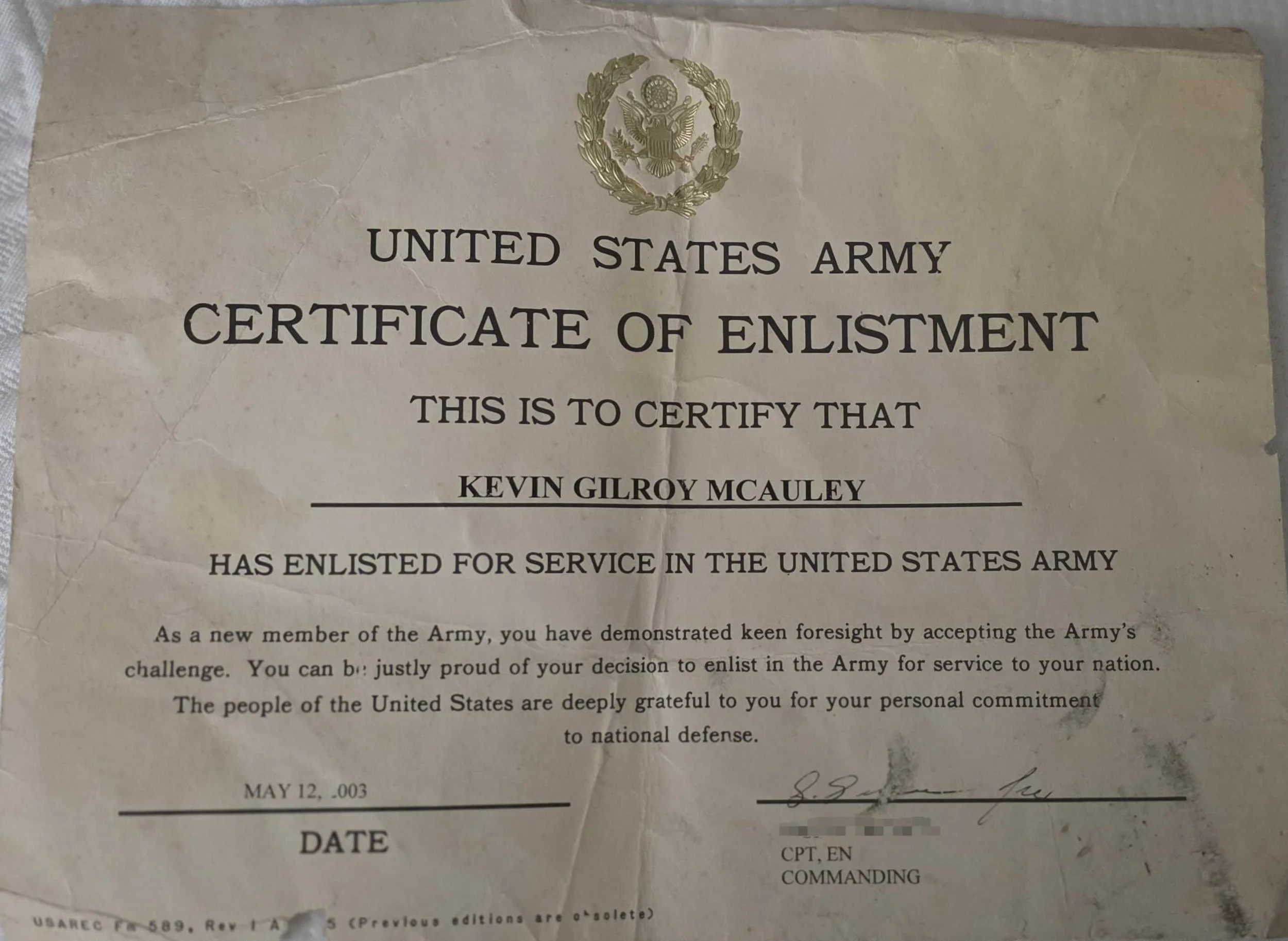
For almost two decades, that was the closest I ever came to true service and sacrifice, until March 19th, 2022, when I married Lisa.
Grounded in being, not performance
Pope Leo XIV writes, in the encyclical this whole series works through, that human dignity "does not depend on a person's abilities, wealth or position in life, nor on the right or wrong choices they have made" (par. 50). A few paragraphs later he names the mistake directly — the idea that every person must earn or justify their own worth, so the more efficient get to count for more, until "persons end up being reduced to a means of achieving results" (par. 51).
He's quoting something older. Two years before this encyclical, the Church's doctrinal office put the same claim in one flat sentence: every human person possesses an infinite dignity, "inalienably grounded in his or her very being" (Dignitas Infinita, quoted at MH par. 53). Grounded in being. Not in a route kept up, and not in the five months I didn't keep mine.
Peter denied the man he'd sworn to follow, three times, in one night — and was still asked, three times back, whether he loved him, and handed a flock to shepherd anyway. I don't want to overplay a pool-cleaning job next to that. But it's the same shape: a clear failure, named without flinching, that never became the whole verdict on the man.
John judged the fit and left the person alone. That's a harder trick than it looks, once you're the one making the call.
The seatbelt test
In the years since, on the other side of that kind of conversation, I've found a few things make it much easier to have, when it has to happen. Clear expectations, stated up front. Being proactive about communication and about the data, rather than waiting for a review to bring it up. Inspecting what I expect, instead of assuming it's happening because I said it once.
People end up knowing where they stand. They know what's expected of them, and they know they're appreciated independently of a sales number or a task-completion rate. Organizational alignment turns out to do most of the actual work: people who want to work with you do the things you've already agreed matter.
Most of the conversations that follow are easy, when they have to happen at all — someone's attitude or their output has slipped, you name it plainly, and it gets back on track, because the standard was never a secret. The ones that are genuinely cut and dry are a different category entirely: someone isn't wearing a seatbelt in a company vehicle, isn't observing the speed limit, isn't stopping at a red light. There's no coaching conversation to have about a red light. The rule was never about performance to begin with.

John never once made it about what I was worth. He told me it wasn't working out, and that cleaning pools wasn't a good fit, and he paid me to help the man replacing me get the route up to speed.
I still don't fully know why telling someone exactly where they stand — and meaning it, regardless of the number — makes the hard conversations easier instead of harder. But it does. Why?
Works Cited
Leo XIV. "Magnifica Humanitas: On Safeguarding the Human Person in the Time of Artificial Intelligence." The Holy See, 15 May 2026, www.vatican.va/content/leo-xiv/en/encyclicals/documents/20260515-magnifica-humanitas.html. Accessed <date pending final draft>.
Dicastery for the Doctrine of the Faith. "Dignitas Infinita: Declaration on Human Dignity." The Holy See, 2024, www.vatican.va/roman_curia/congregations/cfaith/documents/rc_ddf_doc_20240402_dignitas-infinita_en.html. Accessed <date pending final draft> — ⚠ URL and date not verified this session; confirm before publishing.