City of God, The Hunt for Red October, and the Search for Justice

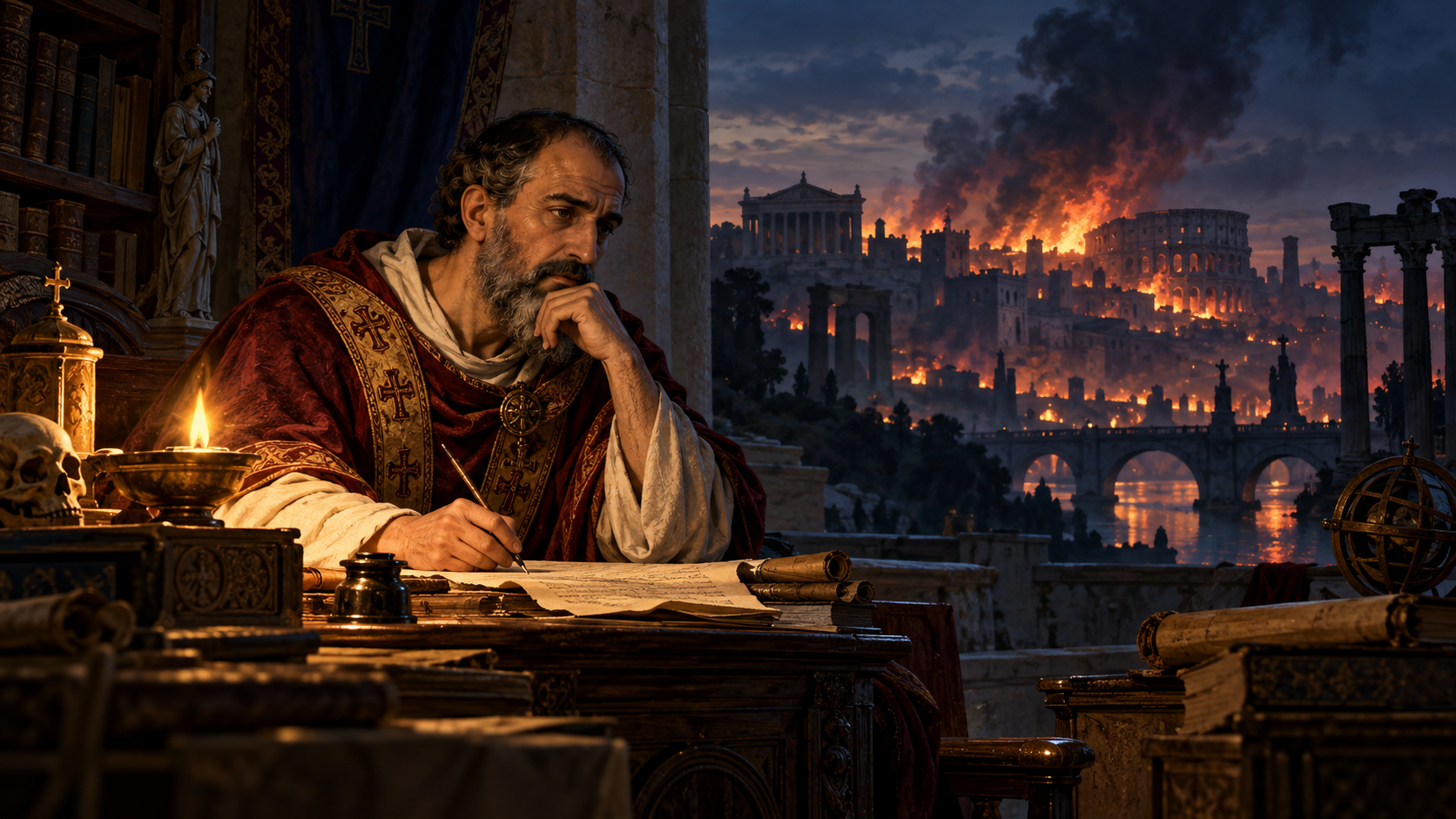
In August of the year 410, a Visigothic army sacked the city of Rome. Many Romans blamed the Christians. In response, Augustine of Hippo began writing The City of God, one of the most important books in Western history. Among its central questions is a simple one: what makes a city just?
Tom Clancy's The Hunt for Red October raises a similar question, with submarines instead of scrolls. Captain Marko Ramius leaves the Soviet Union because it has failed him in the most personal way. Read next to Augustine, his story becomes more than an escape. It becomes a search for justice, and a lesson about where justice can and cannot be found.
A Kingdom Without Justice
Augustine tells a story about Alexander the Great and a captured pirate. Alexander asks the pirate what he means by robbing the seas. The pirate answers that he does the same thing Alexander does. The only difference is size. With one small ship, he is called a thief. With a great fleet, Alexander is called an emperor.
Augustine's point is sharp: take away justice, and a kingdom is just a gang of robbers on a larger scale.
The Soviet Union in Clancy's novel fits that picture. It rules by fear. Political officers watch over military crews. The powerful enjoy protections that ordinary citizens do not. It has laws, a government and a great navy, but those things cannot guarantee justice. For Augustine, power alone does not make authority legitimate. What matters is whether that power serves justice or merely protects those who hold it.
A Wrong No Court Would Hear
Ramius learns this in the hardest way. His wife, Natalia, dies of an illness that should have been easily treated. Nearly every layer of the system fails her at once. The medicine is badly made, and no one checks it. The surgeon is drunk, poorly trained and never properly supervised. When she dies, no one answers for it, because the surgeon's father is an important man in the Party.
Ramius has served the Soviet state his entire adult life. Yet when he needs justice, the state will not give it.
Augustine describes the earthly city as driven by love of self and the desire to rule. Natalia's death shows that desire at every level, from the factory floor to the halls of power. Each person protected himself, and no one protected her.

Her death did not turn Ramius against the system. He had never truly believed in it. What her death destroyed was his only reason for staying.
Justice by His Own Hand
Ramius does not wait for a court. He plans his escape carefully, and on the first day at sea he kills the ship's political officer, Ivan Putin. He substitutes false orders and takes the most valuable submarine in the Soviet Navy.
Here Augustine offers a warning.
In The City of God, he recalls how Romulus killed his brother Remus in the struggle to found Rome. A city that would rule an empire began with bloodshed. Ramius kills to escape a government he believes is unjust. Romulus killed to secure power for himself. Their purposes are different, but both turn to violence to get what they want.
That difference matters. So does the resemblance.
Ramius's care for his crew complicates the picture. Most of his sailors are young conscripts with families waiting at home. He does not tell them the plan, because knowing it would make them part of a crime against the state. Instead, he arranges for them to be sent home safely, innocent of his defection. The officers who share his purpose knowingly accept the risks of seeking freedom.
Augustine was strict about lying, even while allowing concealed strategies in a just war. Ramius uses both secrecy and deception to protect his sailors. His intentions may be honorable, but that does not remove the moral difficulty of his methods.
Nor does his plan unfold without failure.
Igor Loginov, a Soviet intelligence agent hidden among the crew, remains aboard after the evacuation. He kills Gregoriy Kamarov, wounds Ramius and attempts to destroy the submarine.
Loginov chose to murder Kamarov. Ramius neither ordered nor intended that killing. But a captain is responsible for his ship and everyone aboard it. The failure to account for every man during the evacuation left an enemy inside the boat. Ramius may not be guilty of Kamarov's murder, but neither is he entirely free of responsibility for the failure that made it possible.
That is the burden of command. A leader can act with good intentions, take risks to protect his people and still bear responsibility when his plans fail them.
Putin's death is different. Ramius kills him deliberately, believing it necessary to lead his officers to freedom. He owns that decision completely. Whether the killing was justified is a separate question from whether freedom was worth pursuing.
A just cause does not automatically make every means of pursuing it just. Clancy gives us a man worth understanding, even admiring, without asking us to approve of everything he does.
The Better City
Ramius sails for the United States, a republic whose founders drew, in part, on the traditions of ancient Rome. It has courts that can rule against the powerful, a free press and leaders who can be voted out. Its institutions are imperfect, but they offer protections the Soviet system denied him.
Augustine would value those protections. He would also warn against confusing a better government with the City of God.
For Augustine, the two cities are not two nations on a map. They are formed by two loves: love of self above all else, and love of God above self. Their citizens live side by side throughout history, and no country, however good its laws, belongs wholly to either. He doubted that even Rome had ever been truly just.
Still, Augustine valued what he called earthly peace. Order, fair laws and safety are real goods, and citizens of the heavenly city can use and defend them while they live on earth as pilgrims.
The West in Clancy's story is not heaven. It is a place where Ramius has a better chance of living by his conscience, without surrendering himself entirely to the state.
That is no small thing.

What Justice Requires
For Augustine, true justice means giving each one what is due, beginning with God. A city that refuses God his due cannot be fully just to people either. The Soviet state claimed an authority Augustine believed belonged to God alone: ultimate loyalty over a person's life and conscience.
Ramius never gave the state that loyalty, and Clancy shows us something about why.
Ramius was raised in Lithuania by his grandmother, who secretly had him baptized into the Catholic Church. She never told him. In Catholic teaching, baptism is a sacrament that leaves a permanent spiritual mark, a sign of belonging to Christ that can never be erased. Before Ramius belonged to the Navy, before he served the Party, before he swore a single oath, he had been claimed by something beyond the reach of the state.
His grandmother also taught him stories from the Bible, stories about right and wrong, virtue and responsibility. Those lessons stayed with him long after he left her care.
Ramius never truly believed in the Soviet system. He saw its games for what they were: the politics, the paperwork, the careful words that kept a man safe. He learned to play them better than anyone, rising to command the Navy's finest submarine. Over the years, he raised a generation of officers and taught the ones he trusted to play the games as well. They hid their doubts, served with skill and waited. On the outside, they were model Soviet officers. On the inside, their loyalties were more complicated.
But Ramius's conscience was never entirely the state's to command.
His hidden baptism does not explain every choice he makes, nor does it make every choice righteous. He never even knew about the sacrament. Yet Clancy gives us a man whose understanding of right and wrong was shaped by his grandmother's faith, even when the religious teaching itself had faded into memory.
As Ramius leaves his homeland for the last time, he wonders whether her stories about God might be true. If they are, perhaps Natalia is not lost to him forever.
That hope reaches beyond the political freedom he is seeking.
The state could command his service. It could never rightfully claim his soul. When Natalia died, the last thread holding him there was cut, and the conscience he had kept hidden all his life finally showed itself in his actions.
The Search Continues
Augustine wrote that the two cities remain tangled together until the end of time. No earthly victory brings perfect justice.
Clancy's ending can be read in that light. Ramius reaches Norfolk, but his wife is still dead, and the doctor who caused her death has not been brought to justice. The Soviet Union goes on, believing its submarine was lost at sea. Nor does his escape erase the killing of Putin or the failures that cost Kamarov his life.
There is an important difference between the failures that killed Natalia and those aboard Red October. Natalia was failed by people who avoided responsibility, and by a government that protected them from accountability. Ramius also bears responsibility for what happens under his command, including failures he did not intend. His good intentions cannot release him from that burden.
Justice cannot require accountability only from people whose causes we oppose.
What Ramius finds is not perfect justice. He finds refuge, a measure of freedom and the chance at a different life.
Augustine would recognize those as genuine goods, but not the final destination. The pilgrim works for peace and justice in this world while hoping for a peace no government can establish and no army can defend.
The search for justice does not end in America. It ends somewhere no navy can reach.
That leaves a question for the rest of us.
Most of us will never steal a submarine or cross an ocean in search of justice. But every one of us helps decide what kind of city we live in.
We can give God his due and refuse to let any government, institution or leader claim our whole conscience. We can love our neighbors more than our own comfort. We can lead the way Ramius tried to lead his crew, carrying the risks ourselves rather than passing them to the people in our care, and accepting responsibility when our efforts fall short. We can hold the powerful accountable, even when they are on our side. We can show mercy, keep the law equal for the powerful and the weak, and build peace through justice rather than fear.
No city on earth will ever be perfectly just. Our task is to make the one we live in a little more just, so that fewer people must flee it to find justice.
Further Reading
Augustine, The City of God, IV.4 (the pirate and Alexander)
Augustine, The City of God, XIV.28 (the two loves)
Augustine, The City of God, XV.5 (Romulus and Remus)
Augustine, The City of God, XIX.13–21 (earthly peace and justice)
Augustine, On Lying (truthfulness and concealment)
Augustine, Questions on the Heptateuch, VI.10 (ambushes in a just war)
Catechism of the Catholic Church, §1272 (the permanent character of baptism)