Finding Balance
A Practical Guide When Everything Falls Apart
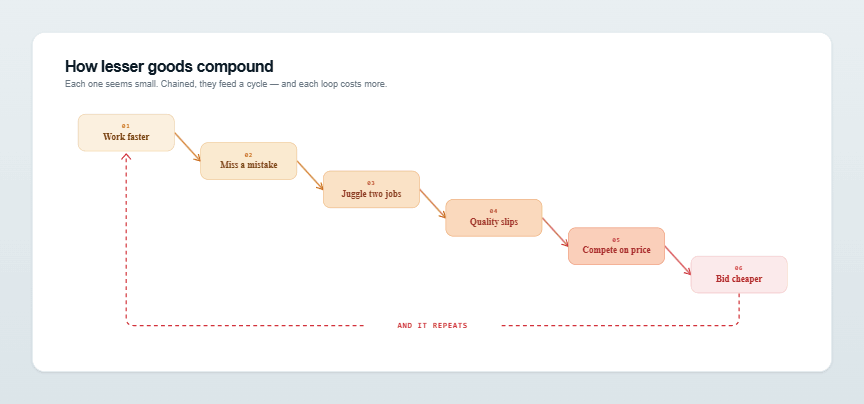
You're in a mess. One job went bad. The weather is making everything slower. You're losing customers to other contractors who can start sooner. You're over budget and behind schedule. Every single problem is pushing you toward choices that seem reasonable in the moment—work a little faster, skip the detailed inspection, start the next job before this one is completely done, give quick answers instead of thorough ones. Each of these choices looks small. But they add up. The key is recognizing that you're not choosing between good and bad. You're choosing between greater & lesser goods. And the lesser goods compound.
What's Actually Happening
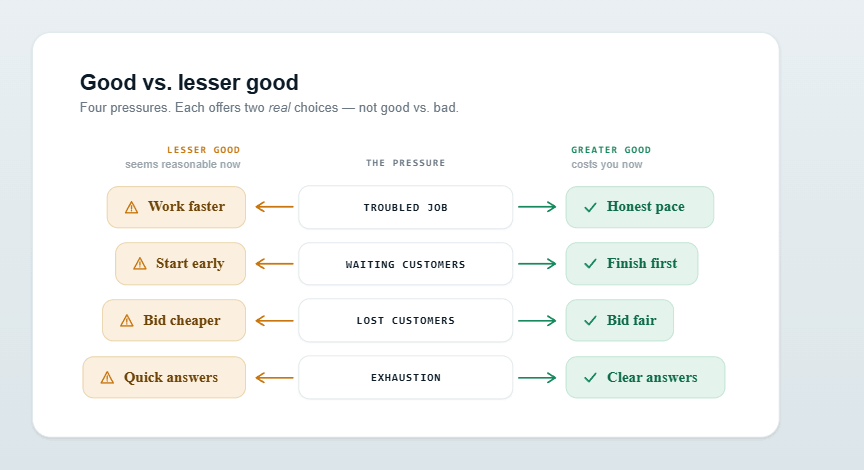
Right now, you're facing pressure in four directions, and each one is offering you a "lesser good"—a choice that seems smart in the moment:
The troubled job offers: "Work faster instead of perfect." That's not the same as "do bad work." It's choosing speed over thoroughness. Reasonable choice when you're behind. But if you do that across ten decisions, you get a job that's done quickly but isn't actually done well.
The waiting customers offer: "Start their work before you're ready, instead of finishing the current job first." Again, not obviously wrong. You could manage two jobs at once. It's a lesser good—you're spreading yourself thin instead of focusing. But it seems practical.
The lost customers offer: "Bid the next job cheaper instead of at fair price." You're not choosing fraud. You're choosing "some money now" over "right money later." That's a lesser good that makes sense when you're stressed about cash flow. But it teaches you to work at unsustainable margins.
Your exhaustion offers: "Give quick answers instead of clear answers. Skip the detailed check. Assume it's fine instead of verifying." These are all lesser goods. You're choosing speed and reduced mental load over thoroughness. Each one seems fine alone.
The trap is that three or four lesser goods start to look like one bad job.
The Balance Between Quality and Speed
You have pressure to work faster. That's real. The temptation is to frame it as: "Do mediocre work or miss the deadline." But that's not the actual choice.
The actual choice is: What is the realistic pace for good work, and will you commit to that instead of the pace you wish was possible?
The structural problem on your current job—how long will it actually take to do it right, in the real conditions you're working in? Not "I hope I can do it in three days." The actual timeline based on what needs to happen.
Once you know that timeline, you stop choosing lesser goods. You stop choosing "work a little faster," "skip the detailed inspection," "do it good enough." You choose the real timeline and you protect it.
This isn't slow work. This is honest work. There's a difference. Honest work moves at the fastest pace that still maintains standards. You're not working slower than you could. You're working at the pace the work actually requires.
The lesser goods start when you try to work at a pace faster than the work requires. That's when you start making small choices that compound.
The Balance Between Now and Later
You have customers waiting. You want to get to them. You also have a current job that isn't done. Both are real. The temptation is to try to do both at half-speed—start the next job before finishing the current one, split your attention, manage two incomplete jobs instead of one complete one.
That's the lesser good: "I can handle both if I just work on them partially." No. You can't. You get two partially-done jobs and two frustrated customers.
The actual balance is: Finish what you started. Be clear about when you can start the next thing. Accept that some people will choose someone else.
This means you call the customers waiting on approved repairs and you tell them: "The current job will be done on [date]. We'll start your work on [date]. If that doesn't work for you, I understand."
That's choosing the greater good over the lesser good. The lesser good is: "Tell them it might start sooner, keep them hopeful, then scramble when you can't deliver." The greater good is: "Tell them the truth, and let them make an honest choice."
Some of them will wait. Some won't. The ones who leave were never going to be happy with you anyway because they wanted something you can't deliver—perfect speed without any sacrifice. Let them go. The ones who stay are your real customers.
The Balance Between Honesty and Money
You're behind. You're over budget. There's a temptation to bid the next job cheap, really cheap, just to have revenue coming in. This looks like a good choice. You get cash flow. You lock in work. It seems practical.
But it's a lesser good. Here's why: If you bid the job too cheap, one of two things happens. Either you can't actually do the work at that price without making the same kinds of small choices that got you into this mess (work faster, skip checks, cut attention), or you complete the job and realize you made almost no money. Then you're right back where you started, but now you're exhausted and you've trained the market to expect cheap prices from you.
The greater good is: Bid what the work is actually worth. If the customer won't pay it, they don't hire you. This sounds irresponsible when you're bleeding cash. But think about it practically.
If you're that desperate for money, you don't have a customer problem. You have a cash flow problem. The solution to a cash flow problem isn't "work for less money." That makes it worse. The solution is (1) a short-term loan from a bank, or (2) putting more crew on the approved jobs so you move through them faster and get paid sooner.
One of those might actually work. Bidding jobs cheap never works. It just delays the problem and creates new ones.
The Balance Between Pushing and Pacing
On the troubled job, you need to move, but not recklessly. The lesser good is: "Just push harder, work longer, ignore the conditions." The greater good is: Work harder, but not dumber.
What does this mean? It means:
Get your best person on the problem immediately (pushing)
But don't let them start tearing things apart before you've fully diagnosed what's wrong (pacing)
Work longer hours if weather and conditions allow (pushing)
But don't work in bad weather where the work will fail (pacing)
Problem-solve fast to find the most efficient fix (pushing)
But don't pick the first solution that comes to mind if it's not the best one (pacing)
The lesser goods are all the small choices to skip a step, work a little longer, ignore a warning sign. The greater good is moving at maximum safe speed.
What Happens When Lesser Goods Compound
Here's the dangerous part: none of these are obviously wrong choices. Taken one at a time, each one seems reasonable. "Work a little faster." "Start the next job a day early." "Give a quick answer instead of a thorough one." "Skip the inspection this time." "Bid a little cheaper to stay competitive."
But here's what actually happens:
You work a little faster on the current job. That creates a small mistake you don't catch because you skipped the detailed inspection. You move to the next job before the current one is truly done. You're distracted, so you don't give clear instructions. The crew does things differently than they should. By the time you realize there are problems, you're already on a third job. Now you have three partially-done jobs instead of one complete job. Your reputation suffers. Customers notice the quality issues. The only way to compete becomes price. So you bid cheaper. Now you have low-margin work. You have to work faster to make money. Which creates more mistakes. Which requires more callbacks. Which costs more money. Which forces you to work even faster.
That's the spiral. It starts with lesser goods that seemed reasonable.
Breaking the Pattern
The balance point is: Choose the greater good in each moment, knowing it might cost you something in that moment.
Choose to finish one job well instead of start two jobs poorly.
Choose to bid fairly instead of cheap.
Choose to give clear answers instead of quick answers.
Choose the realistic timeline instead of the hoped-for timeline.
Choose to tell customers the truth instead of what they want to hear.
In that moment, each of these choices costs you something. Time, maybe money, maybe a customer. But it prevents the cascade of lesser goods that costs you far more later.
In three months, this crisis will be over. The question isn't whether you suffered through it. You will. The question is whether you protected the foundation of how you work—the standards and practices that make you good at what you do—or whether you let the pressure convince you that lesser goods were good enough.
That's where the balance actually matters. Not in grand decisions. In a hundred small choices about which good to choose when both look reasonable.