Pool Repairs and WBS
Work Breakdown Structure and Its Application to Pool Repair Projects
What a WBS Is and Why It Matters
Project management has a vocabulary problem in the trades. Terms like "scope of work," "project plan," and "job estimate" get used interchangeably when they describe fundamentally different things. A Work Breakdown Structure — WBS — is one of those terms that sounds more complicated than it is, and understanding it properly changes how you think about every job that walks in the door.
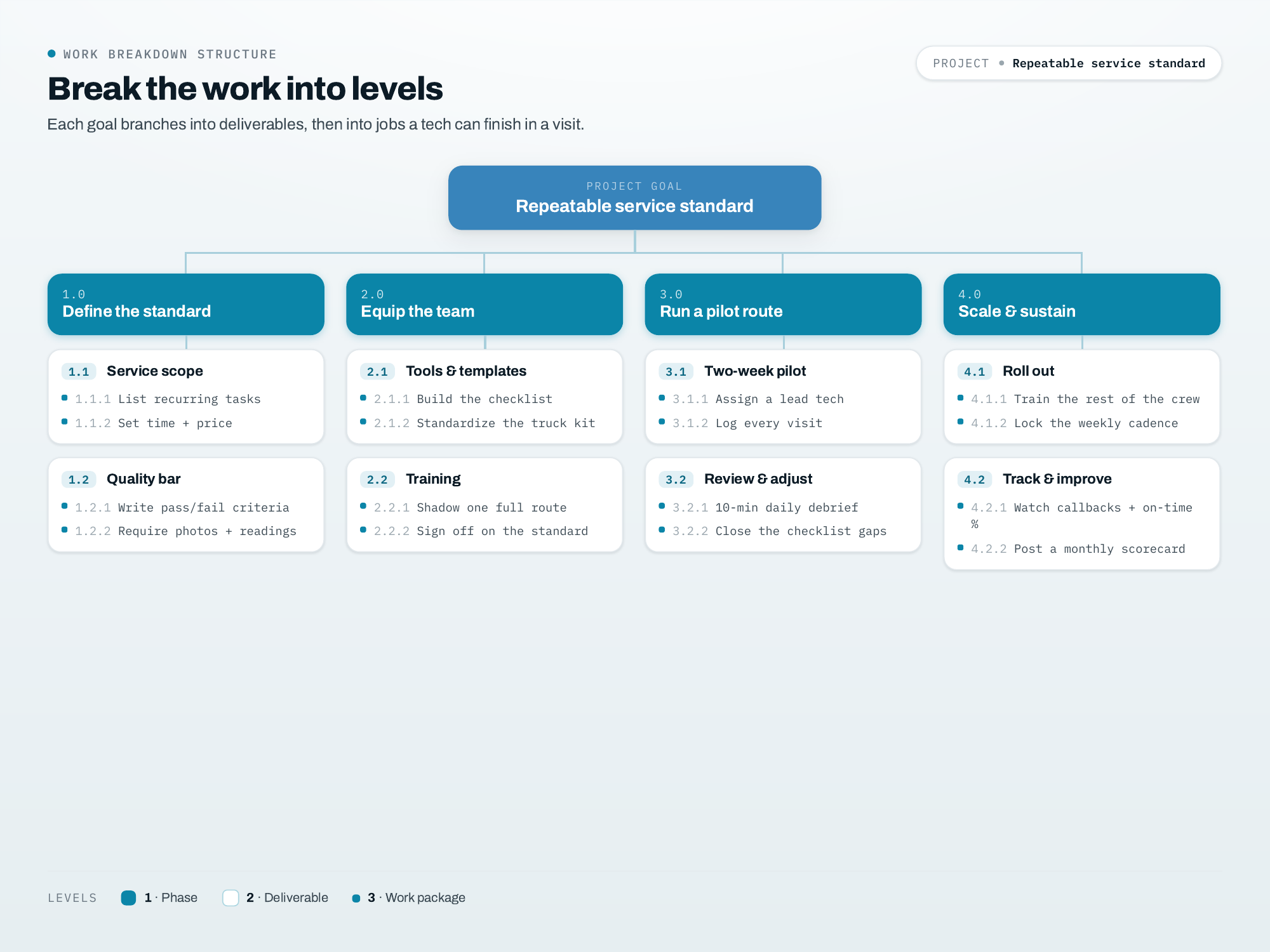
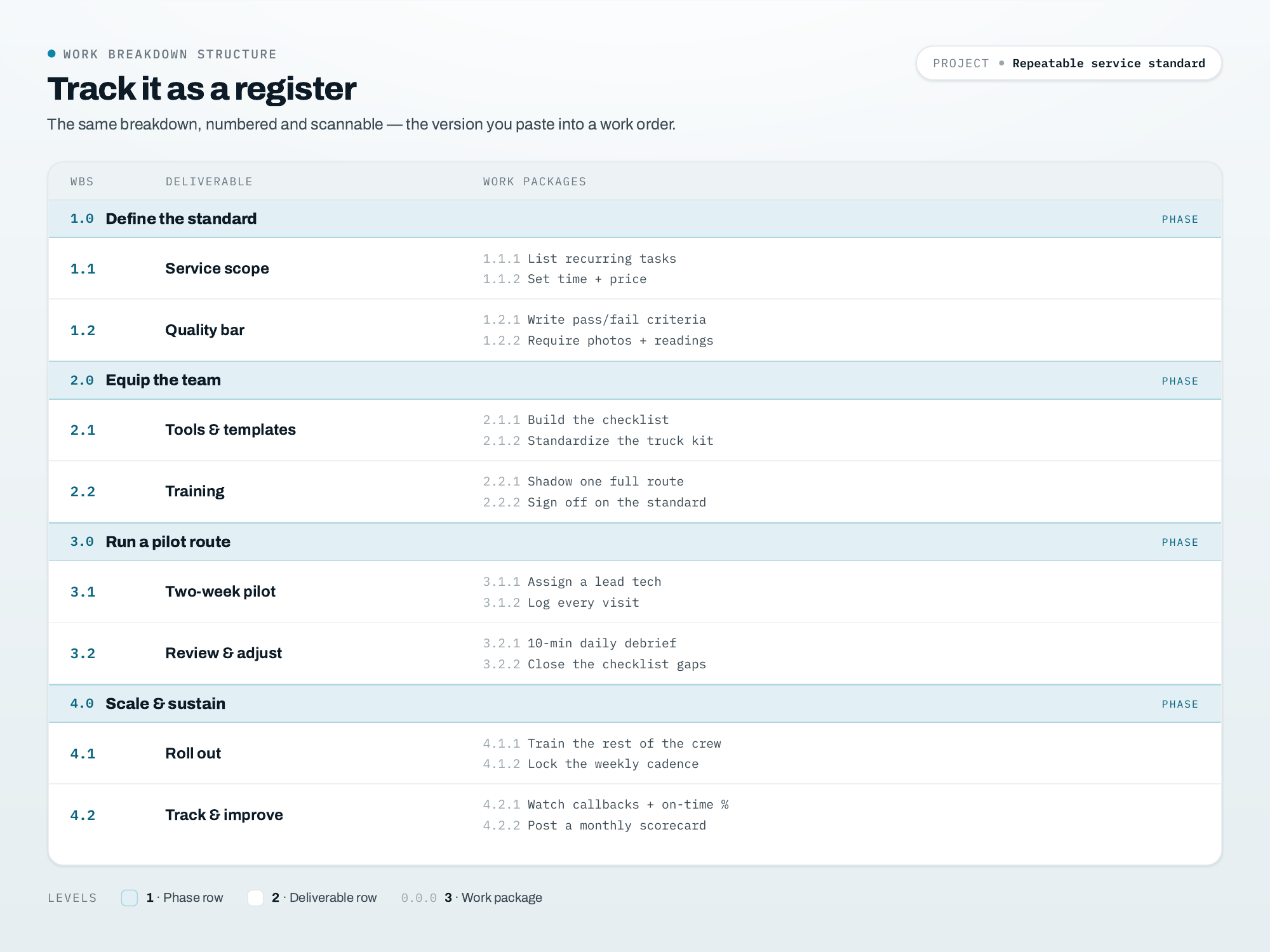
A WBS is simply the complete decomposition of a project into all of its component parts, organized hierarchically from the top level down to the smallest discrete unit of work. At the top sits the project itself. Below that are the major phases or deliverables. Below those are the tasks required to complete each phase. At the bottom are work packages — the individual units of work that can be assigned to a person, scheduled, budgeted, and tracked.
The Project Management Institute, which maintains the globally recognized PMBOK standard for project management, defines the core rule of a WBS as the 100% rule: the structure must capture 100% of the work required to complete the project — nothing more, nothing less. If a task isn't in the WBS, it isn't in the project. If it isn't in the project, nobody is responsible for it, nobody budgeted for it, and nobody will necessarily notice when it doesn't happen.
That sounds abstract until you apply it to a pool renovation where three different things got left out of the original scope and showed up on the final invoice as surprises.
Why Pool Repair Is a WBS Problem
Pool repair work has a characteristic that makes it unusually difficult to scope: the same task can have dramatically different resource requirements depending on what the technician finds on site. "Drain the pool" is a line item on thousands of quotes. It is not a single unit of work. Depending on pool volume, site access, drain infrastructure, and timeline constraints, it might mean:
One electric submersible pump, one technician, forty-five minutes
Two pumps, one technician, half a day
Three gas-powered pumps, two technicians, a full day with site access coordination
All three of those are "drain the pool." None of them cost the same or take the same time. When the quote says "drain pool — $X" and the tech arrives to find a 150,000-gallon commercial pool with no direct drain access, someone is going to absorb the difference. Either the company takes the loss, the customer gets a surprise invoice, or the tech cuts corners on the next job to make up the time.
This is the WBS problem in pool repair: the line items on a quote represent outcomes, not work packages. A work package is defined not just by what it produces but by what resources it requires, how long it takes, what conditions must be true before it can start, and what must be verified before it is considered complete. When those definitions don't exist, every job is being estimated by feel, and the accuracy of that estimate depends entirely on how similar the current job is to the last one the estimator remembers.
The Structure: From Project to Work Package
A WBS for a pool repair project has four natural levels, each answering a different question.
Level 1 — The Project This is the job itself. "Assumption Garden — Commercial Filter and Sand Change." It has a start date, an end date, a customer, and a contract value. Everything below it is in service of completing this.
Level 2 — Phases For most pool repair jobs, phases follow the natural sequence of the work:
Pre-mobilization
Site preparation
Core repair work
System restoration
Closeout and documentation
The phase structure is relatively consistent across job types. A sand change and a full renovation both have these phases — the difference is in what happens inside each one.
Level 3 — Deliverables Each phase contains deliverables — the concrete outputs that have to exist before the phase is complete. Site preparation might contain: equipment isolation, water removal, and access establishment. Core repair might contain: media removal, component inspection, parts installation, and system reassembly. These are the named things a supervisor can check off.
Level 4 — Work Packages This is where the WBS does its most important work. Each deliverable breaks into work packages — discrete units of work with defined resource requirements, duration estimates, and completion criteria. "Water removal" as a work package has a definition: which pump configuration, how many people, what the completion criterion is (pool at X level, confirmed by Y measurement), and what can go wrong.
The work package is the unit that gets assigned to a person, entered into a schedule, and tracked against actual performance. It is also the unit that reveals cost. When "drain the pool" is a work package with three defined configurations, estimating becomes a selection process rather than a guessing process.
The WBS Dictionary: Where Variable Work Gets Defined
The WBS Dictionary is the document that transforms a WBS from an organizational chart into an operational tool. For each work package, the dictionary defines:
Scope statement: what the work package includes and explicitly what it excludes
Acceptance criteria: how you know it is done and done correctly
Resource requirements: labor by skill level, equipment, materials
Duration estimate: expressed as a range or with conditional branches
Dependencies: what must be complete before this can start, and what cannot start until this is complete
Responsible party: who owns this work package
For pool repair, the dictionary entry for "water removal" would look something like this:
Work Package: Water RemovalParent deliverable: Site Preparation
Scope: Complete removal of pool water to a level permitting safe access to the work area. Includes pump setup, active pumping, and pump breakdown. Excludes drain system inspection (covered under Site Assessment) and chemical handling of removed water (covered under Environmental Compliance).
Acceptance criteria: Pool water level at or below [X inches from floor] as measured at the deepest point. No active flow from return lines. Equipment pad accessible and dry.
Conditions and resource configurations:
Condition Criteria Pumps Crew Est. Duration Standard Volume ≤ 50,000 gal, direct drain access, residential 1 electric submersible 1 tech 45–90 min Large volume Volume 50,000–150,000 gal OR commercial site 2 pumps (electric or gas) 1 tech 2–4 hours High volume / restricted Volume > 150,000 gal OR no direct drain access 3 gas pumps + discharge hose run 2 tech 6–8 hours Emergency bypass Drain system compromised or unknown Stop — escalate to supervisor — —
Dependencies: Site Assessment complete. Customer notified of pump noise and access restriction. Discharge point confirmed legal and available.
Responsible party: Lead Repair Technician
This dictionary entry does something the line item on a quote never does: it gives the estimator, the dispatcher, and the technician the same information about what this task actually involves. When the dispatcher creates the Service Appointment, they know whether to send one person or two. When the estimator prices the job, they know which configuration applies based on the site assessment. When the tech arrives on site, they know what they're looking for and what to do if conditions don't match any of the defined configurations.
That last point — what to do when conditions don't match — is where the WBS dictionary connects directly to the Change Order process.
WBS and Change Orders: The Missing Link in Pool Service
The construction industry figured out decades ago that scope change is not an exception — it is a routine feature of working on physical assets in the field. Conditions hidden behind walls, under soil, or inside equipment are unknowable until you're inside them. The industry's answer was not to try to eliminate scope changes but to formalize the process of documenting and authorizing them through the Change Order.
A Change Order is triggered when field conditions fall outside the parameters defined in the WBS Dictionary for a given work package. The tech's job is not to improvise — it is to recognize that the defined configuration doesn't apply, document what they found, and initiate the authorization process for a revised scope.
This is a structural insight that changes how you think about the service form, the project plan, and the dispatch workflow. The WBS Dictionary defines the expected conditions. The service form documents what was actually found. The Change Order bridges the gap when those two don't match.
Without the dictionary, there is no defined "expected condition" to deviate from. Every unexpected finding is handled ad hoc — a phone call, an informal decision, an undocumented change to the scope. Some of those changes get billed. Many don't. None of them build institutional knowledge about how often certain conditions occur, how much they cost when they do, or how to price for them in future estimates.
With the dictionary, an unexpected condition becomes structured data. How often does "water removal" require the high-volume configuration at commercial accounts? The answer is in the Change Orders. Is that cost built into the standard commercial pricing? If not, it should be. The WBS Dictionary transforms field experience into pricing intelligence over time.
Building a WBS for Common Pool Repair Job Types
The practical starting point is not to build a comprehensive WBS for every possible job — it is to build a precise WBS for the five or six job types the team performs most often. For a commercial pool repair operation, those are typically:
Sand and media changes — predictable scope, variable only in filter model and media volume. A well-defined WBS for this job type virtually eliminates estimation error. The Assumption Garden sand change described earlier — three filters, two sites, 2,050 lbs of sand total — is a job where every phase, every work package, and every resource requirement can be defined in advance with high confidence.
Filter component replacement (laterals, O-rings, multiport valves) — moderate variability. Main variables are access difficulty, vessel size, and whether the wet test reveals secondary issues that were not visible before disassembly. The WBS dictionary should define the escalation path when secondary issues are found.
Leak detection — high variability in findings, but the diagnostic process itself is well-defined. The WBS for leak detection separates the diagnostic phase (consistent process, consistent resource requirements) from the repair phase (highly variable, dependent on findings). Quoting the diagnostic phase at a fixed price and treating the repair as a separate job with its own WBS is cleaner than trying to price both together upfront.
Equipment replacement (pumps, heaters, controllers) — moderate to high variability depending on whether existing plumbing and electrical connections are compatible with the new equipment. The WBS dictionary for equipment replacement should include a compatibility assessment work package that happens before the installation work package, with a defined escalation path if compatibility issues are found.
Renovation (replastering, resurfacing, coping replacement) — the highest variability and the job type that most benefits from a formal WBS. Renovation work involves multiple trades, multiple phases with hard dependencies between them, and significant material lead times. The critical path — the sequence of dependent tasks that determines minimum project duration — runs through the plaster cure cycle, which no amount of additional labor can compress.
The Superintendent Problem
GENESIS, the pool industry's most comprehensive technical education program, offers a course titled "Construction Superintendent: Connecting the Field with the Home Office" and identifies the lack of competent, accountable construction managers and superintendents as the single greatest challenge for pool contractors trying to scale their businesses.
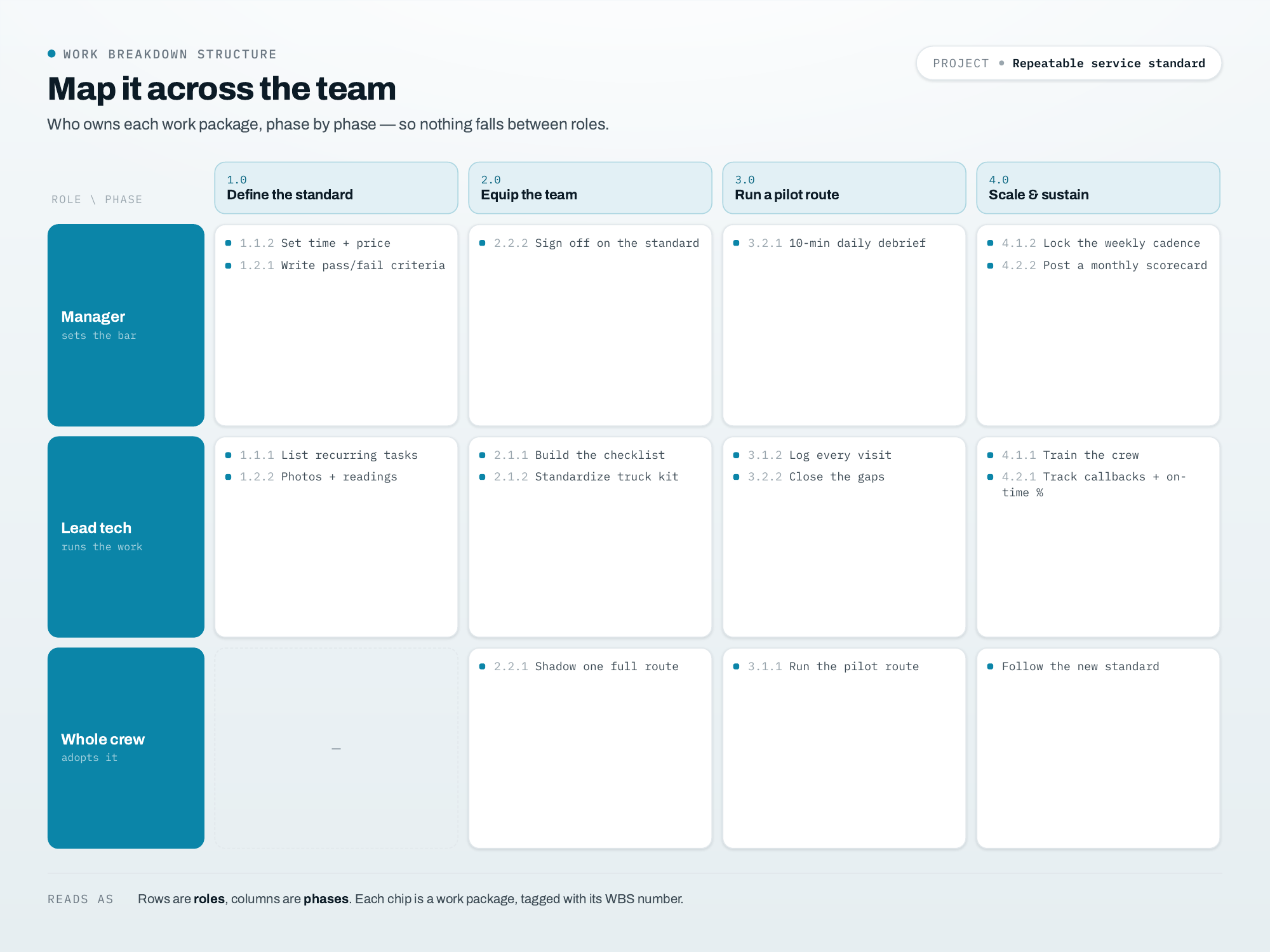
The superintendent role in construction is defined precisely: the superintendent owns the site — managing day-to-day operations, controlling the short-term schedule, coordinating subcontractors, and maintaining quality standards. The project manager owns the office — handling finances, long-term scheduling, and client communication. The two roles share one tool: the WBS. The superintendent executes against it. The project manager tracks performance against it.
In pool service, this division rarely exists as a formal structure. The lead technician on a job is functioning as a superintendent — making real-time decisions about sequence, resource deployment, and quality — but without the documentation infrastructure that makes a superintendent effective. There is no WBS to execute against. There is no formal process to report when field conditions deviate from the plan. There is no structured handoff between what the office sold and what the field is doing.
The WBS Dictionary is the document that creates this connection. It is the shared reference that allows the person in the office and the person on site to be looking at the same definition of the work, making decisions from the same information, and generating compatible records. Without it, the information gap between field and office is bridged entirely by phone calls — which are real-time, informal, unrecorded, and dependent on whoever happens to answer.
What Doesn't Change When You Add a WBS
It is worth being direct about what a WBS is not. It is not a checklist that replaces the judgment of an experienced technician. The technician who has replaced hundreds of laterals knows things that no dictionary entry can fully capture — the feel of a gasket that's about to fail, the sound of a pump that's working harder than it should, the smell that indicates a different problem than the one that was reported. That knowledge is irreplaceable.
What the WBS changes is not what the technician does. It is the information environment around what they do. It defines what was expected so that deviations can be recognized. It defines completion criteria so that quality is not subjective. It defines resource requirements so that the right tools and people arrive at the right time. And it creates the structured record that transforms individual field experience into organizational knowledge — the kind that improves estimates, informs training, and survives employee turnover.
The gap in pool service is not technical competency. PHTA's certification pathway addresses technical competency rigorously. The gap is operational documentation — the shared language between the person who sells the job, the person who dispatches the crew, the person who does the work, and the person who bills for it. The Work Breakdown Structure, and the dictionary that gives it life, is that language.