Root Cause Analysis for Pool Technicians:
Using a Failing Pump to Learn How to Find the Real Problem
Every pool technician has chased a problem that came back. You replace the pump motor, and it dies again a week later. You reset the breaker, and it trips again the next morning. That loop is frustrating, it costs the owner money, and it makes you look like you missed something. The good news is there is a proven method built to break the loop. It is called Root Cause Analysis, or RCA.
RCA is a careful way of thinking that helps you find the real reason something failed, instead of just fixing the part you can see. This article is about the method itself — how it works and why it works. We will use pool pump and electrical problems as the example the whole way through, because they show the idea so clearly. Once you learn to think this way, you can use it on almost any problem on the equipment pad.
The big idea: a symptom is not the cause
This is the heart of RCA, so start here.
A symptom is the sign you notice. It is the thing that made the phone ring. "The pump keeps shutting off" is a symptom. So is "the breaker won't stay on" and "the water has a tingle."
A root cause is the deeper reason that created that symptom. RCA is the work of getting from the symptom to the root cause.
Here is a simple example. The symptom is a pump motor that keeps shutting off because it overheats. It would be easy to blame the motor and replace it. But the root cause might be a wire that is too thin for a long run from the panel to the pump. When the wire is too thin, the voltage — the electrical "push" that moves power — gets weak by the time it reaches the motor. A weak push makes the motor work harder and run hot. Replace the motor and you treated the symptom. The new motor will cook too. Fix the wire and you removed the cause. That is the whole point of RCA in one story.
Why quick fixes fail: the cause hides up the chain
RCA teaches something that surprises a lot of people. One root cause can create a chain of failures. The part that finally breaks is often the last thing in the chain, not the cause. If you only fix that last part, the problem comes right back.
Picture this. A pump runs dry because it lost its prime (prime is the water that fills the pump so it can move more water). Running dry burns up the mechanical seal, which is the part that keeps water out of the motor. With the seal gone, water leaks into the motor and ruins the bearings, the parts that let the shaft spin smoothly. A tech who only presses in new bearings will be back in a month, because the real cause — the pump running dry — was never touched. The bearing failure is two steps downstream of the cause.
The same trap shows up in electrical work. A safety device keeps tripping every morning, so someone keeps replacing it. That costs money and changes nothing, because the real cause is moisture inside the motor, far from the device they keep swapping. RCA is what keeps you from paying to fix the wrong thing twice.
The steps of Root Cause Analysis
RCA is not magic. It is a set of plain steps you can follow every time, shown in Fig. 1.
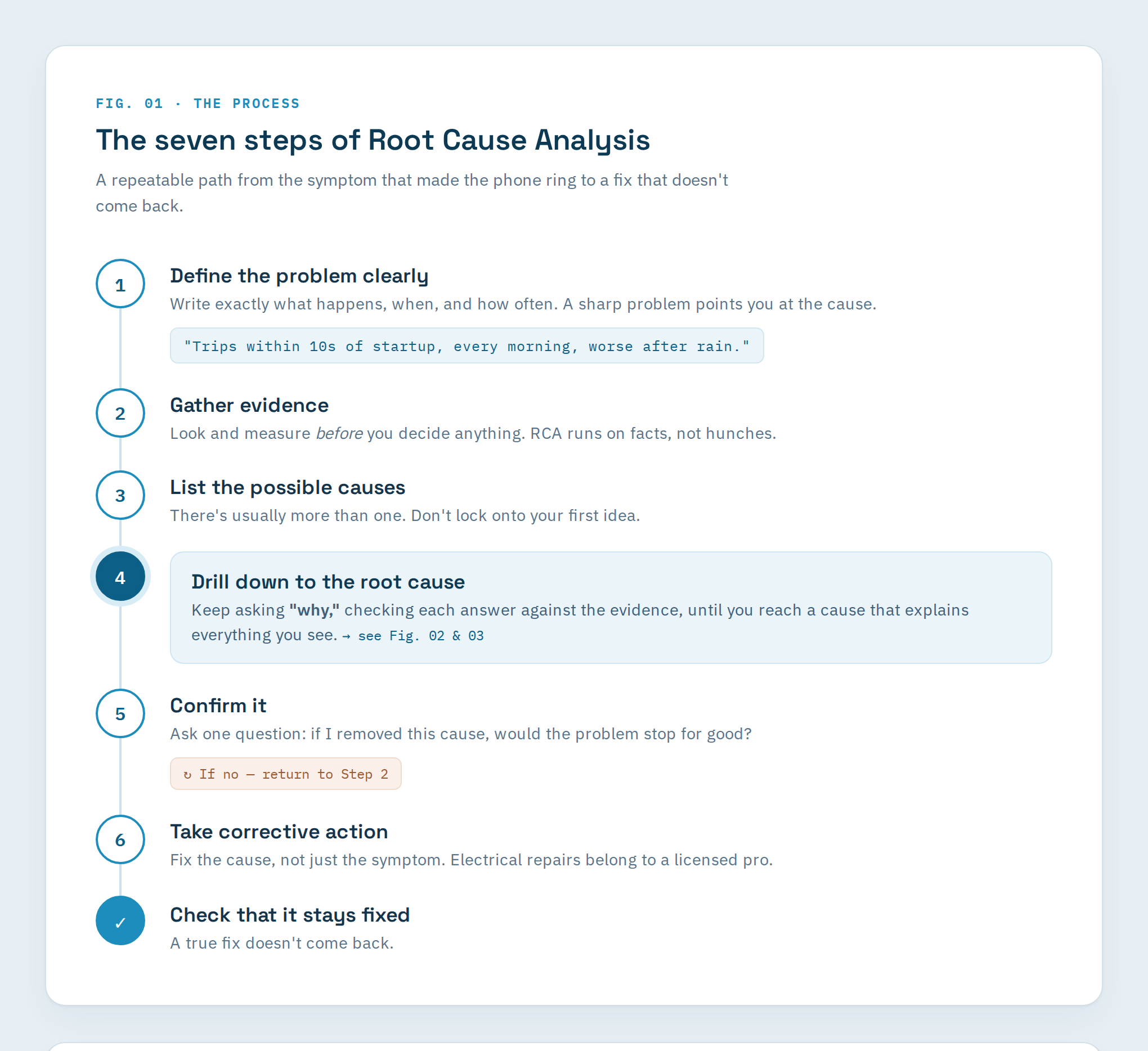
Steps 3 and 4 are where the real work happens, here are two simple tools handle them.
The 5 Whys
The 5 Whys follows a single problem down one branch. You ask "why" about five times in a row, each answer based on something you saw or measured, until you reach the root cause. Fig. 2 walks through the overheating-motor example from start to finish — each "why" peels back one layer until it lands on the real cause: a wire too thin for the run.
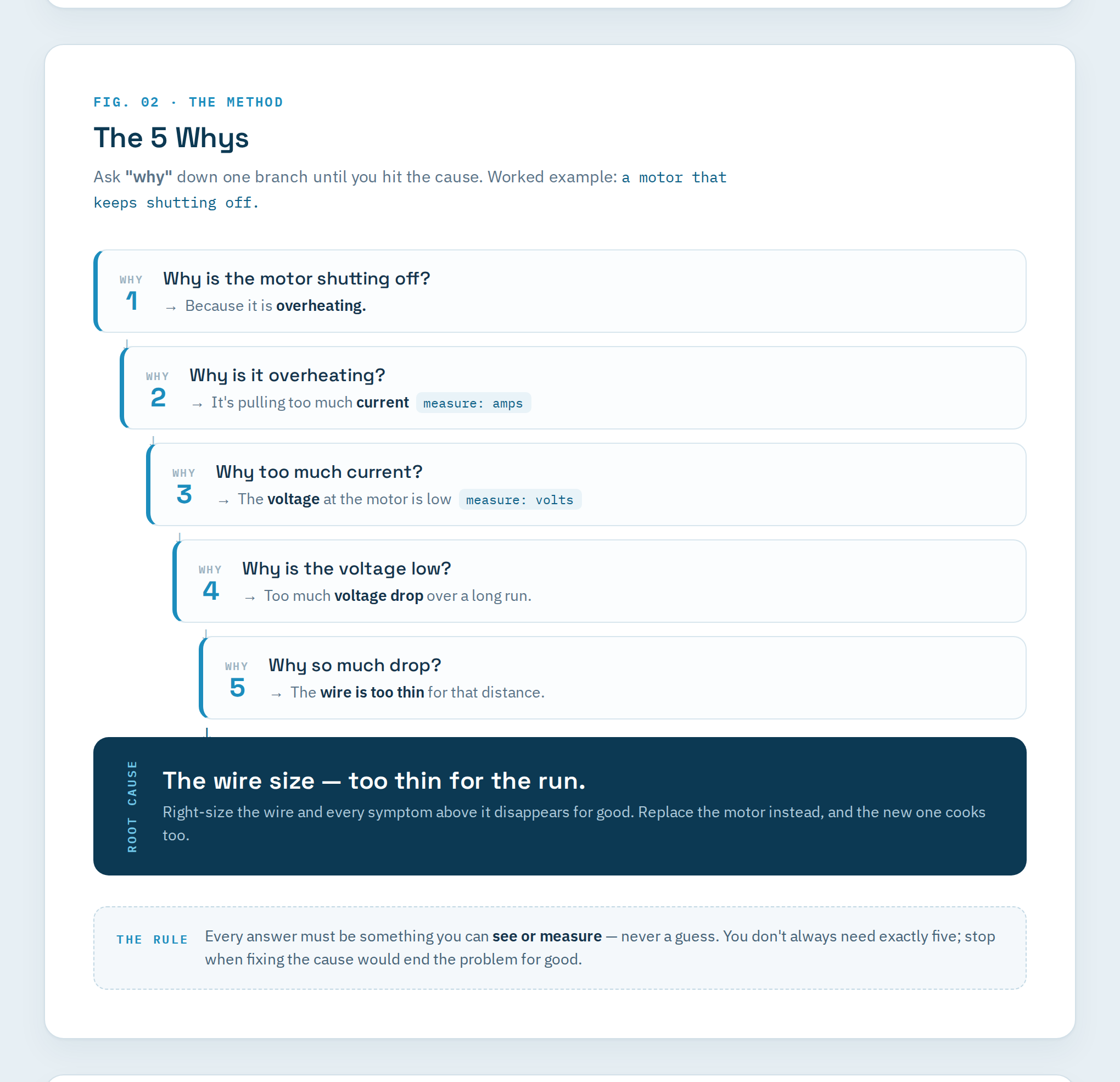
The rule that makes the 5 Whys work is simple: every answer must be something you can see or measure, never a guess. And you do not always need exactly five. You stop when you reach a cause that, if fixed, would end the problem for good — right-size that wire and every symptom above it disappears.
The Fishbone diagram
Sometimes a problem has many possible causes at once, and a single line of "whys" can send you down the wrong path. A Fishbone diagram (also called an Ishikawa diagram, named after the man who created it) keeps you organized. It is shaped like a fish skeleton: the problem is the head, and each "bone" is a group of possible causes. Fig. 3 maps a tripping pump into four groups — power supply, the motor, water, and the device and controls — so no suspect gets forgotten.
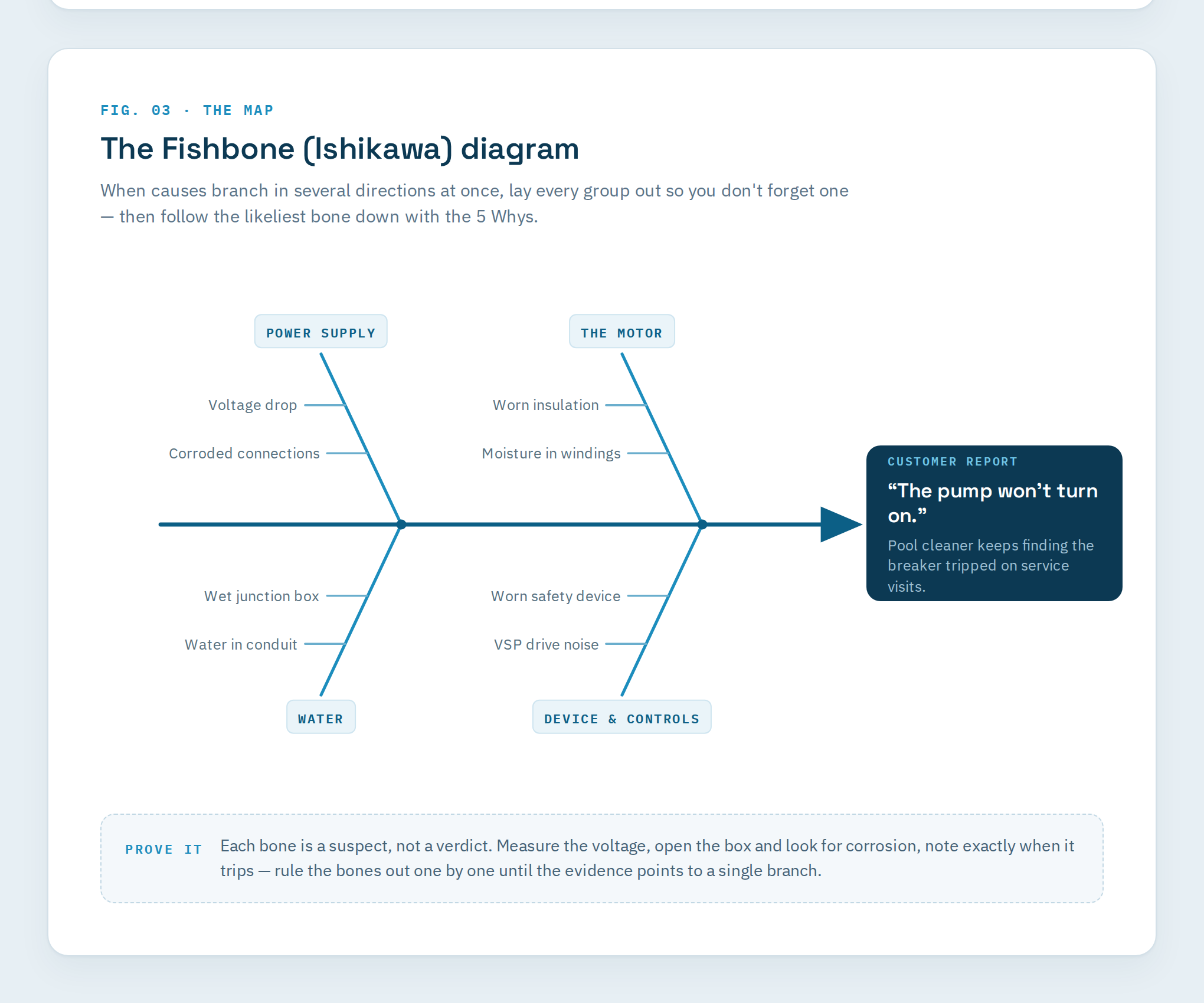
Use the Fishbone when the causes branch wide, and use the 5 Whys to follow the most likely bone down to the bottom. Together they cover both directions — one spreads the suspects out, the other digs.
Prove every step
If there is one habit that separates good RCA from guessing, it is this: prove every step with evidence. Each "why," and each bone on the Fishbone, has to be backed by something you saw or measured. Measure the voltage. Open the box and look for corrosion. Note exactly when the trips happen. A guessed cause leads to a guessed fix, and a guessed fix comes back.
So when that safety device trips, you do not pick "moisture in the motor" because it sounds right. You check it, and you rule out the other bones one by one. Only the evidence tells you which branch is real. That discipline is the difference between a problem solved once and a problem solved over and over.
Doing RCA inside your lane
Here is an important point for pool techs. Doing Root Cause Analysis does not mean you do every repair yourself. You run the analysis as far as your safe role allows, then hand off the repair.
For electrical problems, the actual repair — the wiring, the ground fault protection, and the bonding — must be done by a licensed electrical contractor. A few terms worth knowing as you hand off:
GFCI stands for Ground-Fault Circuit Interrupter. It is the safety device that shuts power off fast when it senses power leaking where it should not go, like through water or a person. Near a pool, it can save a life.
The NEC, or National Electrical Code, is the rulebook for safe wiring. It requires GFCI protection on pool pump motors.
Bonding means tying all the metal parts around the pool together with a heavy copper wire so they all sit at the same electrical level. When everything is at the same level, no power can push through a swimmer. A tingle in the water is a warning sign that bonding has failed, and it is serious.
Your job is to safely define the problem, gather what you can see with the power off, and point to the likely root cause. Doing that analysis well is your value. You hand the electrician a solved puzzle, not a mystery.
Use RCA to tell the story two ways
When you finish the analysis, you have something powerful: a clear root cause. Now you explain it to two very different people.
To the property owner, keep it plain. They want to know if it is safe, what it will cost, and what happens next. Try: "The safety switch keeps shutting the pump off. I traced it back to water getting into the motor — not the switch itself. That is the real cause. A licensed electrician needs to make the repair, and I've written down what I found so they can go straight to it and not charge you to hunt for it."
To the electrician, be specific. Give them your RCA in order: the clearly defined problem, the evidence you gathered, the equipment (brand, model, horsepower, and whether it is single- or variable-speed), what recently changed, and your best guess at the root cause. A clear handoff saves the electrician time and saves the owner money, and it makes you the tech they trust.
The takeaway
Root Cause Analysis is really a habit of mind. You stop blaming the part that broke and start asking what made it break. You define the problem in plain facts, you prove every step with what you can see and measure, and you follow the chain all the way to the bottom before you call it solved.
The failing pump is only our example. The same method works on green water, a heater that won't fire, or a salt system acting up. Define the problem, gather the proof, drill to the root cause, fix the cause, and confirm it is gone. Do that, and you stop fixing the same pool twice.