Back On Track
Exercising Productive Constraints
At the Water’s Edge: 2 of 12
I became a rink supervisor the fall of my senior year, on early work release from high school, at a local ice rink. The job on paper: opening, closing, sales reconciliation, oversight of the public-session staff — skate guards, the rental counter, admissions, cleaning. I'd relieve the opening manager most weekday afternoons and close Thursday, Friday, and Saturday nights myself.
James, the opening manager, taught me things nobody expects to teach a seventeen-year-old. Where the air-handler filters sat in the drop ceiling, and how to change them every month. How to read the ice on a Saturday night and cut it properly — edging, cross-cuts, enough water down for a glass finish by the five a.m. figure-skating class. Keys. The safe combination. How to reconcile the till.
That was real subsidiarity, though I wouldn't have had the word for another twenty-five years: authority handed to the smallest capable unit, with the training that makes the authority usable. He wasn't stepping back and hoping it worked out. His 1994 green Ford Ranger could have broken down in the rain on the way in and he still would have made the 4:45 open, because he gave himself that much margin, every morning, arriving at 4:15. On the weekends I opened myself, I came screaming into the parking lot at 4:55. Same shift. Different margin.
Just going with the flow
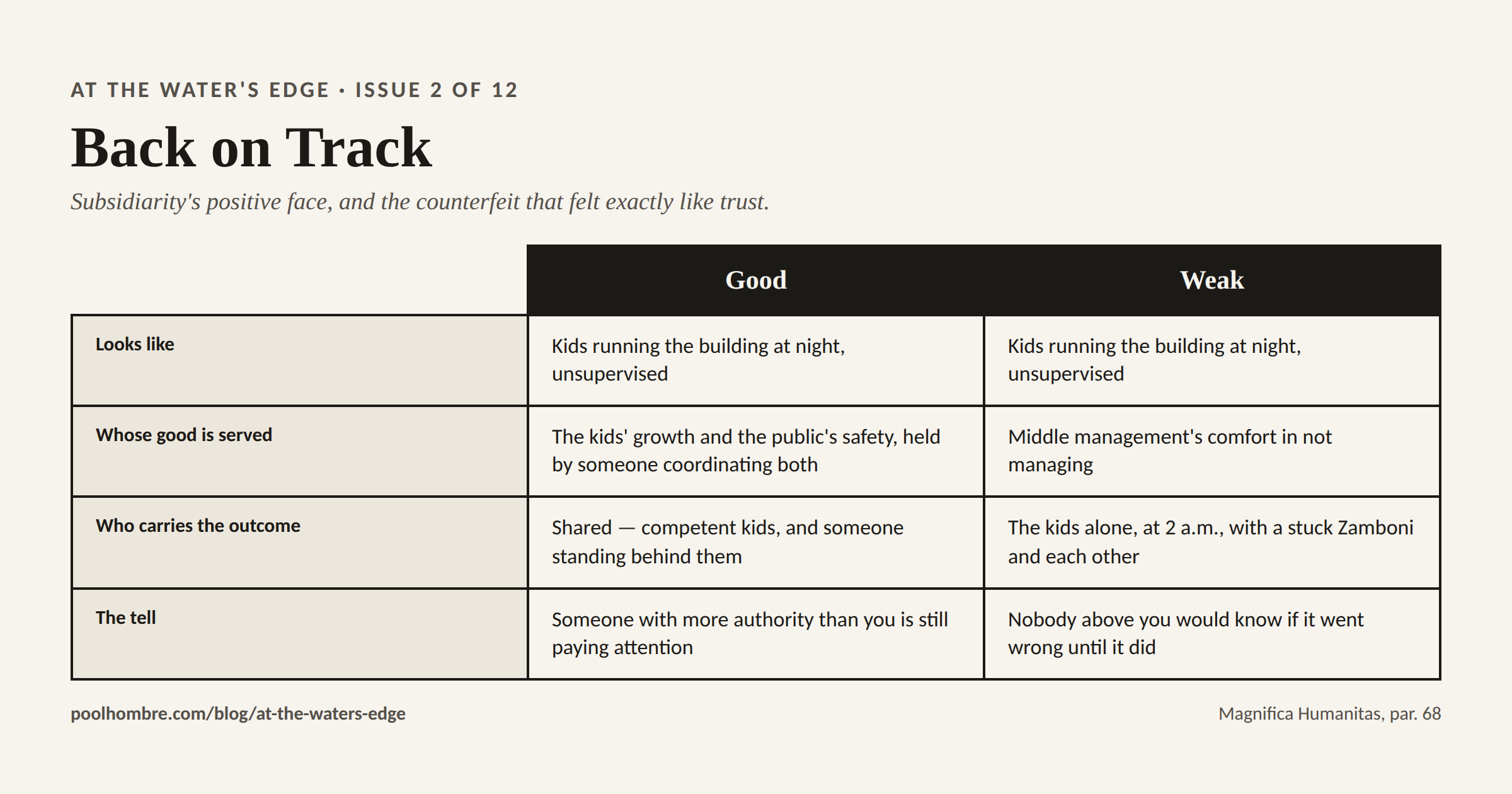
Middle management above James turned over somewhere in there, and the new people did what new people sometimes do when a program is already running: they went with the flow. The flow, for a group of seventeen- and eighteen-year-olds who now had driver's licenses and building keys, went somewhere predictable. After ice maintenance on a Saturday night, the old supervisors used to let us skate for a while before locking up. Under the new management, "a while" got longer. Friends got invited. Some nights we played hockey until the small hours and called it closing procedure.
Looking back, there was a real breakdown in oversight, and the only thing standing between that and nothing at all was one man's discipline. Not a policy. Not a supervisor. A Ford Ranger that showed up on time every single day.
It felt like trust. It was actually just nobody watching.
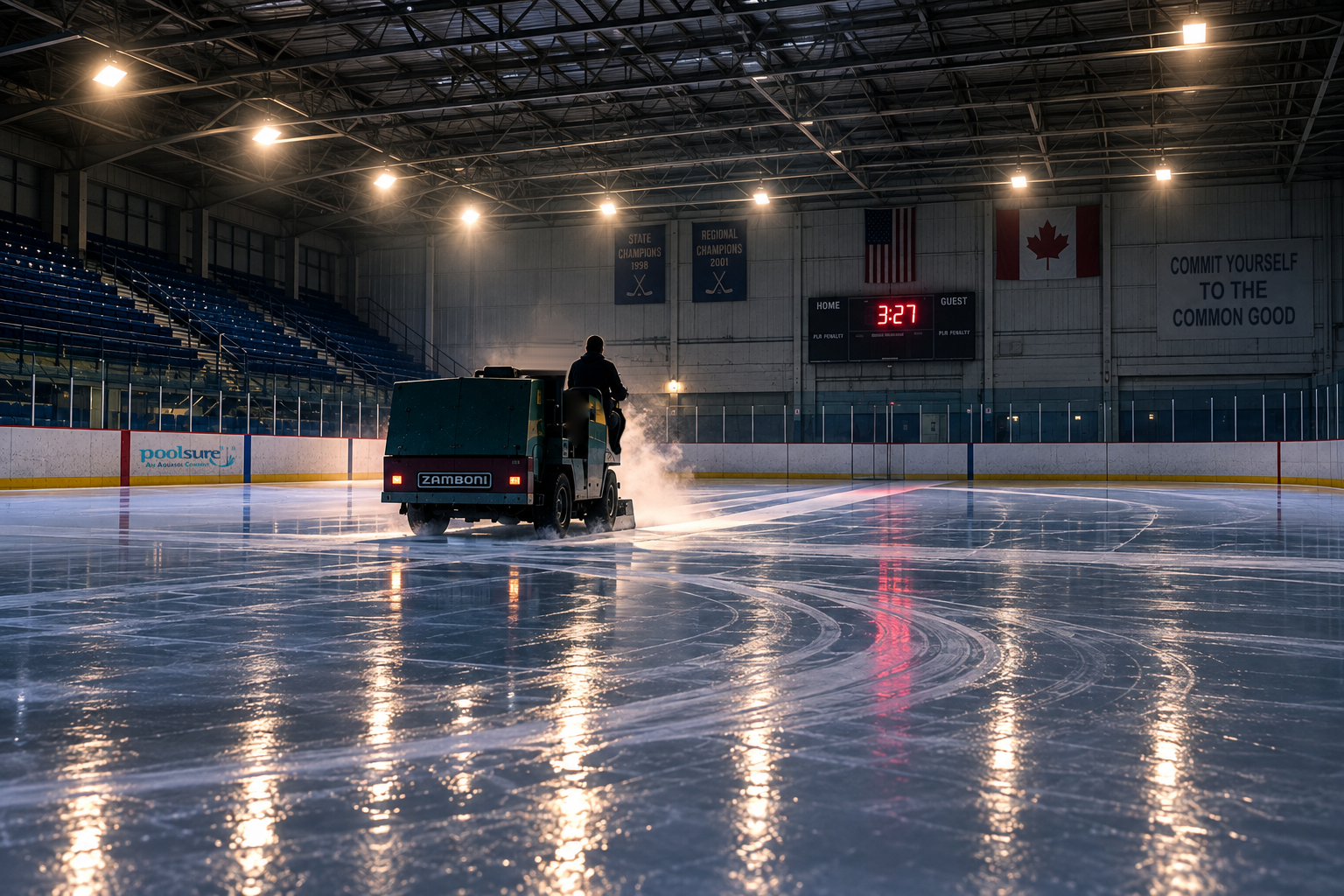
One of those nights, after skating, I started the closing cut so the ice would be ready for the 5 a.m. class. Music on, lights on, staff hauling out trash bags, and I ran the tight corkscrew dry cross-cuts first, then backed the blade off a turn or two and started my last pass — long and slow, dumping as much hot water as I could for a glass finish. Coming into the turn at the end of that pass — a long, lazy 270 degrees toward the machine bay — I let off the accelerator and held tight to the left-side striker plate — the right side was my blind spot going through that opening, and hugging left was the only way to keep clear of it — raised the conditioner as the wheels hit the concrete, to clear the kickplate, and killed the augers in the same motion. Pulled forward until the conditioner cleared the bay gates, dropped it in neutral, hopped down to close the gate behind it.
An hour and a half to opening. All that was left: dump the waste ice, set the fill hose, log the compressor readings, kill the lights and the music, and we'd be at IHOP for chicken strips in twenty minutes.
I turned to climb back into the seat and the Zamboni was rolling backward on its own, wheel cocked. Pulling forward now meant driving the conditioner into the wall. I jumped in and hit the brake. It kept creeping. Threw it in drive — it lurched forward, the conditioner nearly slamming the wall — and a voice yelled from the blind side, one of the skate guards: "Wait! Brake!" Back to neutral. Still creeping. I shut it off.
The right front tire had climbed the track above the waste pit and was hanging over a five-foot drop. I had the fix — back up with the wheel cranked, drop back into the track — except the gates were already closed behind me, and every time the engine turned over the machine lurched backward on its own, brake or no brake. Forward was a trip to the hospital, or the unemployment line, or both.
I spent a long time doing what felt like a twenty-seven-point turn, trying to work the conditioner free without tipping several thousand pounds of machine into a concrete pit, before deciding the Zamboni's own engine couldn't be trusted at all. What could pull it out that wasn't its own engine? My Jeep, backed around to the loading door, an extension cord braided into a tow line, 4-Low, and a slow crawl backward. The cord stretched to something like a third longer than it was built for before it snapped.
That's about when James walked in for his 4:15 — already asking why the music was so loud. I hadn't heard it in over an hour. I'd stopped hearing it somewhere around the second time I tried to back a several-thousand-pound machine off a concrete ledge with a Jeep and an extension cord — fixated on the one problem instead of the whole one: a public building that needed to open on schedule.
I pointed and explained. He didn't ask how it happened. He turned, picked up a spare section of grate leaning against the wall, and dropped it over the open pit — looked at me, and I understood, and grabbed the second section while he walked back to the Zamboni, started it, drove it forward off the ledge, and reversed it cleanly into the tracks. Mission accomplished, in about ninety seconds, by a man who never raised his voice once.
What the hive offers instead
There's a show i started watching this year, Pluribus, where humanity gets absorbed into a single contented hive mind, and the one man who refuses it, Manousos, burns his own car in the middle of a jungle rather than accept a ride from the thing that is absorbing everyone else. It looks like stubbornness. It is closer to the opposite — a refusal to let something make his decisions for him in exchange for making them easier. Meanwhile Carol, immune like he is but alone, stands watching her own house burn down and cannot make herself care. Total comfort, zero coordination with anyone, turns out to be its own kind of erasure. Two failures, symmetrical, on either side of the same missing thing: someone actually present, actually coordinating, who is neither absorbing you nor leaving you to it.
That is the whole story of the rink, at a smaller scale than a television show needs to make the point. Pius XI put the first half of it on paper in 1931: "it is an injustice and at the same time a grave evil and disturbance of right order to assign to a greater and higher association what lesser and subordinate organizations can do" (Quadragesimo Anno, par. 79). Leo XIV, in the encyclical that gave this series its name, sharpens the verb list: higher-level institutions exist to "recognize, protect and promote the freedom and creativity of lower-level entities, coordinating their contributions so that they can cooperate effectively for the common good" (Magnifica Humanitas, par. 68). Four verbs. Coordinating is one of them, and it is not a synonym for staying out of the way.
James did all four. He recognized what a seventeen-year-old could actually handle, protected the facility and the kids in it by showing up, promoted real competence by teaching the trade instead of just handing over keys, and coordinated — present every morning, reading the compressor logs, checking the ice. The management that turned over above him did one thing: they recognized we had keys. They skipped the other three and called the difference trust.
St. Joseph gets one line in every issue of this series, and this is his: "he did as the angel of the Lord commanded him" (Matthew 1:24) — no recorded word of his own anywhere in scripture, just the act. James was the same. He didn't lecture me about the Zamboni. He just showed up and did the next right thing, which is a harder trick than it sounds and the only kind of authority that actually coordinates instead of talking about coordination.
Coordinating
I develop tools for technicians now, instead of running them directly — workflows, data quality, the systems that sit between a person and the call he has to make on-site. The diagnostic question is the same one, aimed at what I actually build: does this tool recognize what the person on the other end can already do, or does it just recognize that I can require him to use it? Is it coordinating help toward his judgment, or standing in for judgment I have quietly decided he does not need? There is a name in the literature for building the second kind and calling it efficiency — laissez-faire leadership just moves upstream — and the research is not kind to it: measurably associated with role confusion, conflict, even bullying, wherever it has been studied (Skogstad et al.). An unwatched system is not a neutral vacuum either. It is its own kind of weather, and the person on the other end of it lives there whether or not anyone who built it ever checks.
James is retired now, somewhere, and I doubt he ever thought of the Ford Ranger as doctrine. Years later I brought the extension cord up to him at his house. He laughed. In his telling it wasn't even a story — just the kind of thing that happened. I remember it every time I decide not to check in on someone I have told myself I trust.
Who is driving your Zamboni tonight, and how would you actually know if it started rolling?
Works Cited
Leo XIV. "Magnifica Humanitas: On Safeguarding the Human Person in the Time of Artificial Intelligence." The Holy See, 15 May 2026, www.vatican.va/content/leo-xiv/en/encyclicals/documents/20260515-magnifica-humanitas.html. Accessed 15 Sept. 2026.
Pius XI. "Quadragesimo Anno." The Holy See, 15 May 1931, www.vatican.va/content/pius-xi/en/encyclicals/documents/hf_p-xi_enc_19310515_quadragesimo-anno.html. Accessed 15 Sept. 2026.
The Holy Bible, Matthew 1:24. Revised Standard Version.
Skogstad, Anders, et al. "The Destructiveness of Laissez-Faire Leadership Behavior." Journal of Occupational Health Psychology, vol. 12, no. 1, 2007, pp. 80–92.
Pluribus. Created by Vince Gilligan, Apple TV+, 2025–.