The Difference between Good and Weak
At the Water’s Edge; 1 of 12
The sun had been down less than fifteen minutes.
I was standing on the edge of the footboard, grit and fiberglass clinging to my toes, peering at something submerged in the shadows. Halos ringed out from the pool lights. A hundred bathers filled two thousand square feet of water gone inky blue-black, invaded by incandescent yellow beams. I rubbed my eyes. I wished I had my regular glasses.
I looked across the pool to the other guard.
The object floated lifeless, in shadow, beneath parents playing catch with their kids. Was it a person? It did not really look like one. But it moved just enough that it could have been a child.
I could not enter the water safely. It was too crowded. My eyes darted for options.
Fifteen seconds. Twenty. Twenty-five.
Then two things arrived at the same moment. The first was that I was failing to recognize an incident. The second was worse: staring at that one shape was intruding on my primary surveillance duty. For twenty-five seconds I had been watching one ambiguous object instead of ninety-nine other people.
Time to make a call.
I blew my whistle. Loud, sharp, annoying, and fifteen minutes early for adult swim. I pointed into the shadow and yelled to the nearest adult. "Hey, get that for me."
It was a T-shirt.
Not a person. Not a child drowning. A T-shirt. I breathed out, and I finished my shift, and I have gone back to those twenty-five seconds for twenty-five years.
Why I did not act sooner
I have never had a satisfying answer, only an honest one. I was afraid of being wrong.
Not afraid of the water. Not afraid of the rescue. Afraid of being the guard who cleared a packed pool fifteen minutes early, in front of a hundred people, for a piece of laundry.
The standard is not complicated. You act on suspicion, not on certainty. If in doubt, you go. The reason is arithmetic, not courage. If I am wrong about a T-shirt, the cost is a whistle, some annoyance, and my own embarrassment. If I am wrong about a child, the cost is a child. Those two errors are not the same size, and it is not a close call.
I knew that at nineteen. I could have recited it. And I still spent twenty-five seconds trying to convert a suspicion into a certainty, because certainty was what would protect me.
Those twenty-five seconds were not neutral. There is no watching-and-waiting on a guard stand, because attention is finite and I had spent all of mine on one shadow. I was not gathering information. I was not deciding, and the pool went unwatched while I did it.
Delay is not the absence of a decision. It is a decision, made by default, whose cost lands on somebody else.
The footage
Years later I sat in a training class and watched security footage of a man on the edge of a footboard.
His eyes are drawn to something in the water. Concern. Confusion. He sits back down.
A few minutes pass. He stands again, looks at the same place. Concern, then something closer to alarm. He sits back down.
A few minutes after that, a scheduled guard change puts fresh eyes on the pool. Within seconds the new guard is in the water, pulling a child off the bottom.
I watched that man stand up and sit down twice and I thought I was watching myself.
I was not. He was not a lifeguard. He was a concession stand employee covering the stand for a lifeguard who was late. He had never been trained to tell the difference between an active drowning victim, a passive one, and a distressed swimmer. He saw a body in the water. He saw an adult near it. He concluded they were playing.
That is not an unusual mistake. It is the most common one there is. A passive drowning victim does not thrash or call out. Motionless in a busy pool, a child who is dying looks almost exactly like a child who is floating. Recognizing the difference is a trained skill, and he had not been given it.
The child did not survive.
I was able to watch that footage at all because the child's parents released it for training, so that what happened in front of that young man could be used to teach other people to see. Every detail that could identify the child, the family, the employee, or the facility has been withheld, and I will not answer questions about any of them. But I am not going to leave the footage out of this, because the only reason it exists outside a case file is that a family decided people like me should have to look at it.
The organization did not give that young man the training he needed to recognize what he was seeing. The family did. The people with the least obligation to supply it are the ones who supplied it, and they paid a price for it that no organization has ever paid.
It was not me on that stand. It could have been.
He and I did the same thing on the same kind of afternoon. We stood, we looked, we doubted, we sat back down. The distance between his afternoon and mine was not courage and it was not character.
It was that somebody had trained me to convert a suspicion into an action, and nobody had done that for him — because somebody above us both had decided that a late lifeguard could be covered by whoever happened to be free.
That decision was made in an office, by a person who was not there, probably in a hurry, almost certainly without malice. It is the kind of decision I make now.

What I did when I finally moved
The simplicity of the solution still suprises me.
I blew a whistle nobody expected. And then I turned to a stranger and said four words: "Hey, get that for me."
No explanation. No case for why it mattered. No attempt to bring him along or check whether he agreed. A direct instruction to a man I had never met, who did it immediately.
Twenty-five years later I have been a lifeguard, a pool cleaner, a pool manager, a territory supervisor, a repair technician, an instructor trainer, a service manager, and now a national field-service leader. I have authority over other people's work, and I almost never speak to them the way I spoke to that man in the water.
I do not give orders. It is not my style. I would rather a person share my vision than be told to. When someone brings me a problem, my instinct is to ask questions that clarify the problem for them. When I need something done, my instinct is to explain why it matters until they want it too.
I have carried that as a virtue for most of my career. It sounds like respect. It sounds like developing people instead of using them. It sounds like the opposite of the manager who barks and points.
I am no longer sure that is what it is.
Some of it is that I do not want to be responsible for the coming and the going. If I persuade you and it goes wrong, we decided. If I direct you and it goes wrong, I decided. Consensus is a comfortable place to stand when an outcome is uncertain.
Some of it is worse. Some people want clear direction, and I falter at giving it — distracted by the possibilities, wanting them to agree with my idea instead of execute the tasks that would achieve it. I have mistaken enthusiasm for readiness. I have left a capable person holding a decision that was mine to make, and I have called it empowerment.
I gave a clear command to a stranger in a pool because I believed a life might depend on it. What I cannot get out of my head is what I think is at stake the rest of the time, and what exactly the persuasion is protecting.
The challenge
I have been reading Pope Leo XIV's encyclical Magnifica Humanitas: On Safeguarding the Human Person in the Time of Artificial Intelligence. It is a document about empowering people. It is a long argument about power — who holds it, whom it serves, and what it does to the person on the other end.
Its fifth chapter is titled "The Culture of Power and the Civilization of Love." I read that and put myself on the right side of it immediately. I do not dominate. I have never wanted to.
Then I reached subsidiarity, and it stopped being comfortable.
Subsidiarity is usually explained in the negative. A higher authority should not absorb or supplant what a lower one can do for itself. Push decisions down. Stay out of the way. That reading has been very convenient for me.
But the word comes from subsidium, which means help. And the encyclical states the principle with active verbs. "Higher-level institutions must recognize, protect and promote the freedom and creativity of lower-level entities, coordinating their contributions so that they can cooperate effectively for the common good" (par. 68).
Recognize. Protect. Promote. Coordinate. Those are not instructions to stand back. They are obligations to supply something.
So the principle has a second half I had quietly skipped. When the lower level genuinely cannot accomplish the thing on its own, the higher level is required to help. Withholding what someone needs is not deference to their autonomy. It is a failure to render aid.
The concession stand employee did not have too little authority. He had too much, and nothing to exercise it with.
Good and weak
This is the distinction I want to spend a year on. Not domination against service — most of us already know we should not bark. The harder pair is the one nobody warns you about.
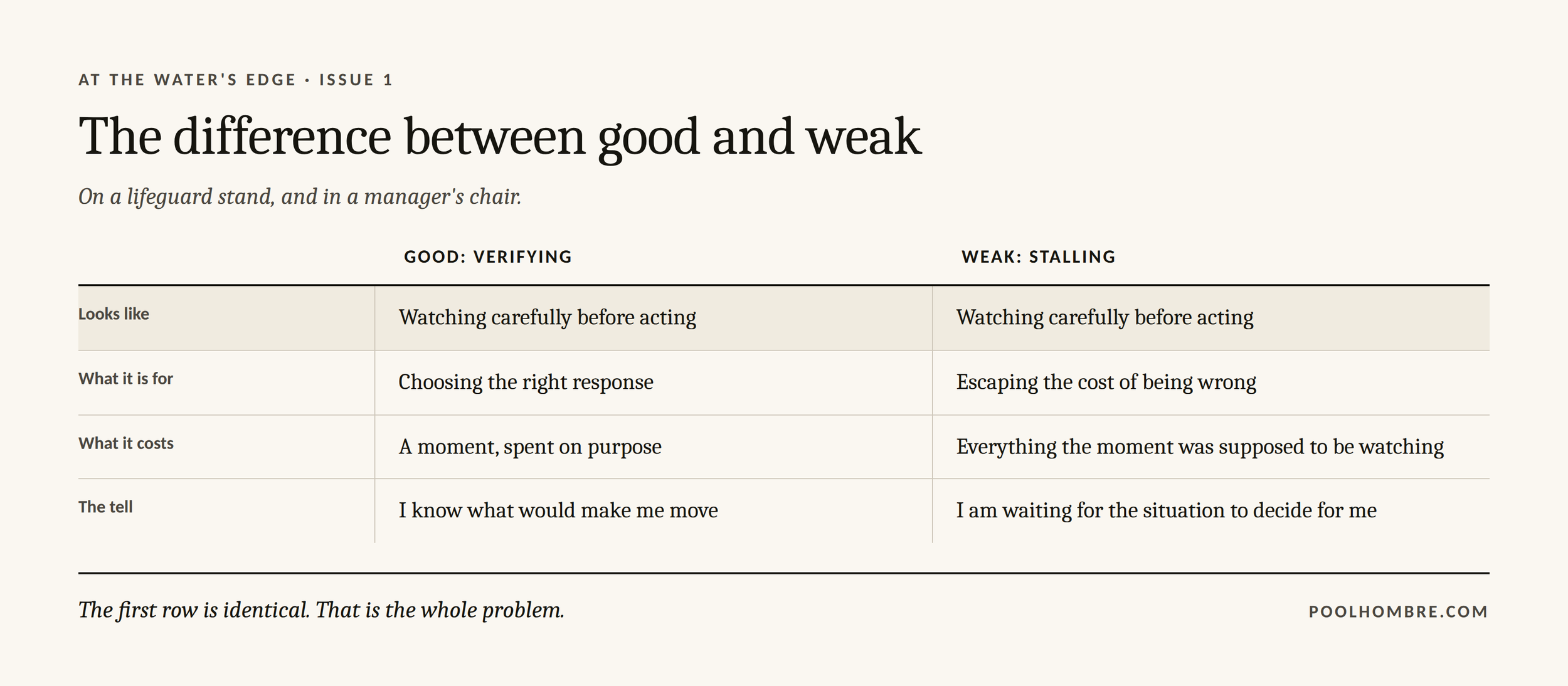
Start with the one from the footboard.
Good: verifying Weak: stalling Looks like Watching carefully before acting Watching carefully before acting What it is for Choosing the right response Escaping the cost of being wrong What it costs A moment, spent on purpose Everything the moment was supposed to be watching The tell I know what would make me move I am waiting for the situation to decide for me
The first row is identical. That is the whole problem, and the footage is the proof of it. Two men, two footboards, the same posture, the same doubt, the same sitting back down. From the outside you could not tell which one was a trained professional taking a beat and which one was a young man with no framework watching a child die.
Now move it off the deck and into a chair. Consulting your team and avoiding your decision produce the same meeting. Humility and abdication produce the same silence. The tell is the same, too: a good manager knows what would end the discussion. A weak one is waiting for consensus to arrive and relieve him of authorship.
I have been that second manager while believing I was the first one, for years, and from the inside they feel almost exactly alike. Thomas Aquinas had a name for the second one, and it is not a flattering one.
He puts magnanimity — greatness of soul, "stretching forth of the mind to great things" — between two failures. On one side, presumption: assuming to do what is above your power. On the other, pusillanimity: refusing to stretch to what is commensurate with your power. Littleness of soul.
He calls it a sin, and the example he reaches for is the servant in the parable who buried his master's money in the earth "through fainthearted fear."
That servant did not lose anything. He protected it. He gave back every coin. That was the sin.
Aquinas also closes the exit I had been using. Magnanimity and humility are not opposed; they consider different things. Humility never asks you to decline an act you are capable of. So whatever my restraint was, on that footboard, it was not modesty.
Nobody told me it was free
There is a second half to my own night that is not about my character at all.
A hundred bathers in two thousand square feet. The dusk transition, the hardest fifteen minutes of a guard's day, when the surface turns to glare and the depth turns to ink. Incandescent light throwing halos across black water. A guard on duty without his corrective lenses. A pool too crowded to enter for a rescue. And a nineteen-year-old deciding, alone, in real time, whether to risk public embarrassment on a maybe.
Those are not facts about my courage. They are facts about design, staffing, scheduling, and policy — every one decided by somebody above me, none of them decided that night.
What was the bather load limit, and who enforced it? Who owned the sunset transition — was there a scheduled clear, or was it left to whoever was on the stand? Was eyewear a line on an opening checklist or a personal problem? Who was allowed to sit on a stand when a guard ran late, and who had authority to say nobody swims until a certified guard is here? And the one that matters most:
Had anyone ever told me, out loud or in writing, that clearing the water on a suspicion is always the right call and will never be second-guessed?
No. Nobody had ever told me guessing wrong was free. So I priced it myself, and I paid twenty-five seconds.
That is what a failure of subsidium looks like in a facility. Not a manager barking. A manager absent, having pushed a life-and-death judgment down to the deck without pushing down the training, the standing, or the permission to make it badly.
And the tools we are buying now
I am genuinely excited about what technology is doing to this work. I use AI to understand complicated systems, build better tools, and cut the hours hardworking people spend fighting broken processes. I do not think it is opposed to us.
But it is not neutral either. It carries the priorities of whoever designed it, financed it, bought it, and deployed it — and a manager looking for somewhere to set down his own responsibility will find these tools very willing to take it.
A drowning-detection system would probably have flagged my shadow. It would also have flagged the T-shirt. Which means the hard question was never the machine's accuracy. It is whether the organization has decided, in advance and in writing, who acts on an ambiguous alert and whether that person is free to be wrong.
It would be easy and false to say a camera would have saved that child. Maybe it would have. But an alert only matters if it reaches somebody who has been trained to understand it and permitted to act on it. Put a detection system above a concession stand employee who has never been taught what a passive drowning victim looks like, and you have not solved the problem. You have added a light that nobody has been told what to do about.
Every tool that removes a difficult human moment also removes a place where responsibility used to live. Somebody has to put it back, deliberately, by name.
The diagnostic
Two questions, one for each chair.
On the stand: do I know what would make me move, or am I waiting for the water to make it obvious?
In the office: if this goes wrong, who will be said to have decided — and did I arrange that?
Closing
Human dignity, the encyclical says, does not depend on a person's abilities, wealth, or position in life, nor on the right or wrong choices they have made (par. 50). That was true of the child pulled off the bottom of that pool. It is also true of the young man who stood up twice and sat back down. He was not a coward and he was not negligent. He was unequipped, and the people who left him unequipped were not on the deck to see what it cost.
Early on, the encyclical says something I have needed. "No one can single-handedly bear the weight of the challenges the world is facing, just as no one is so weak that they cannot play their part, for 'power is made perfect in weakness'" (par. 13). And a page before that: true fulfilment is not achieved by eliminating weakness, but through harmonious growth (par. 12).
That is the only reason I am willing to write a series like this in public. It is not a license to leave the weakness sitting there — naming a habit is the first move against it, not a substitute for the work.
But it cuts the other way too, and this is the part I keep returning to. No one can single-handedly bear the weight. That young man was made to.
Over the next eleven issues I want to take one challenge at a time from this encyclical into the world I actually know: instruction, competition, guard stands, plant rooms, service vans, municipal budgets, and the software we are all now buying. Every time, the same question. What does the good version of this look like, and what does the weak version look like when it is wearing the good version's clothes?
I do not have it worked out. That is why I am writing it down.
It was not me on that footage. It could have been. And I am now the kind of person who decides who sits on the stand.
A family turned the worst thing that ever happened to them into a training film so that the rest of us would be equipped. The least any of us owes them is to make sure the person we put on the stand has been taught what they are looking at, and told that being wrong is free.
So I will start with the people who have stood where I stood. When you hesitated on a call — on a stand, in a plant room, on a phone — what were you actually afraid of? And had anyone ever told you that being wrong was free?
Works Cited
Leo XIV. "Magnifica Humanitas: On Safeguarding the Human Person in the Time of Artificial Intelligence."
The Holy See, 15 May 2026,
www.vatican.va/content/leo-xiv/en/encyclicals/documents/20260515-magnifica-humanitas.html. Accessed 6 Aug. 2026.
Thomas Aquinas. Summa Theologiae. Translated by the Fathers of the English Dominican
Province, 2nd ed., Benziger Brothers, 1920. New Advent,
www.newadvent.org/summa/. Accessed 6 Aug. 2026.